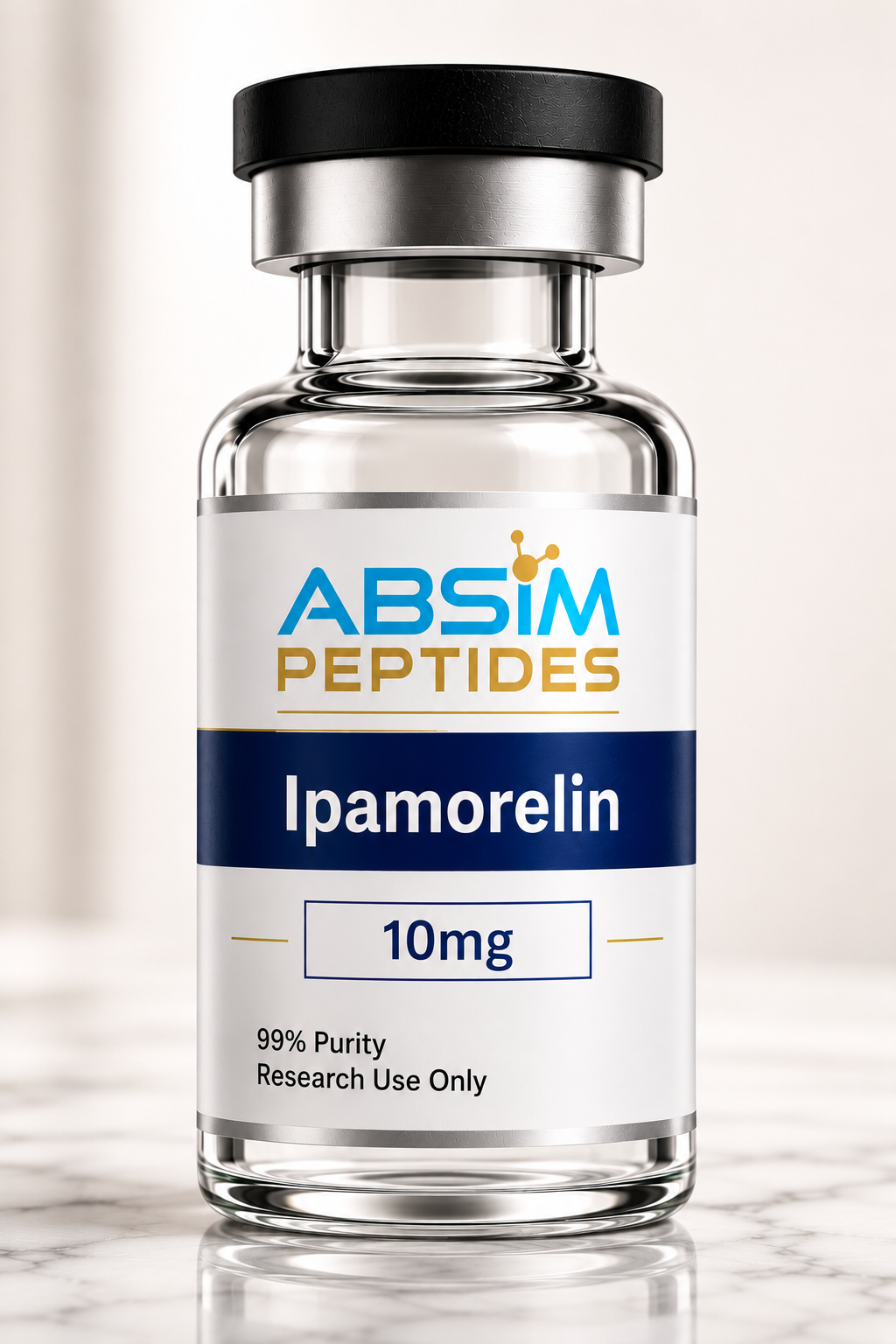
Ipamorelin 10mg
$29.00 – $175.00Price range: $29.00 through $175.00
This product is intended as a research chemical only. This designation allows the use of research chemicals strictly for in vitro testing and laboratory experimentation only. All product information available on this website is for educational purposes only. Bodily introduction of any kind into humans or animals is strictly forbidden by law. This product should only be handled by licensed, qualified professionals. This product is not a drug, food, or cosmetic and may not be misbranded, misused, or mislabeled as a drug, food, or cosmetic.
Additional information
| SKU | IPA1020260423-01 |
|---|---|
| Categories | Peptides |
| Weight | 1 lbs |
| Dimensions | 3 × 2 × 2 in |
| MG | 10 |
| Purchase Type | Single, 10 Pack |
Ipamorelin Peptide
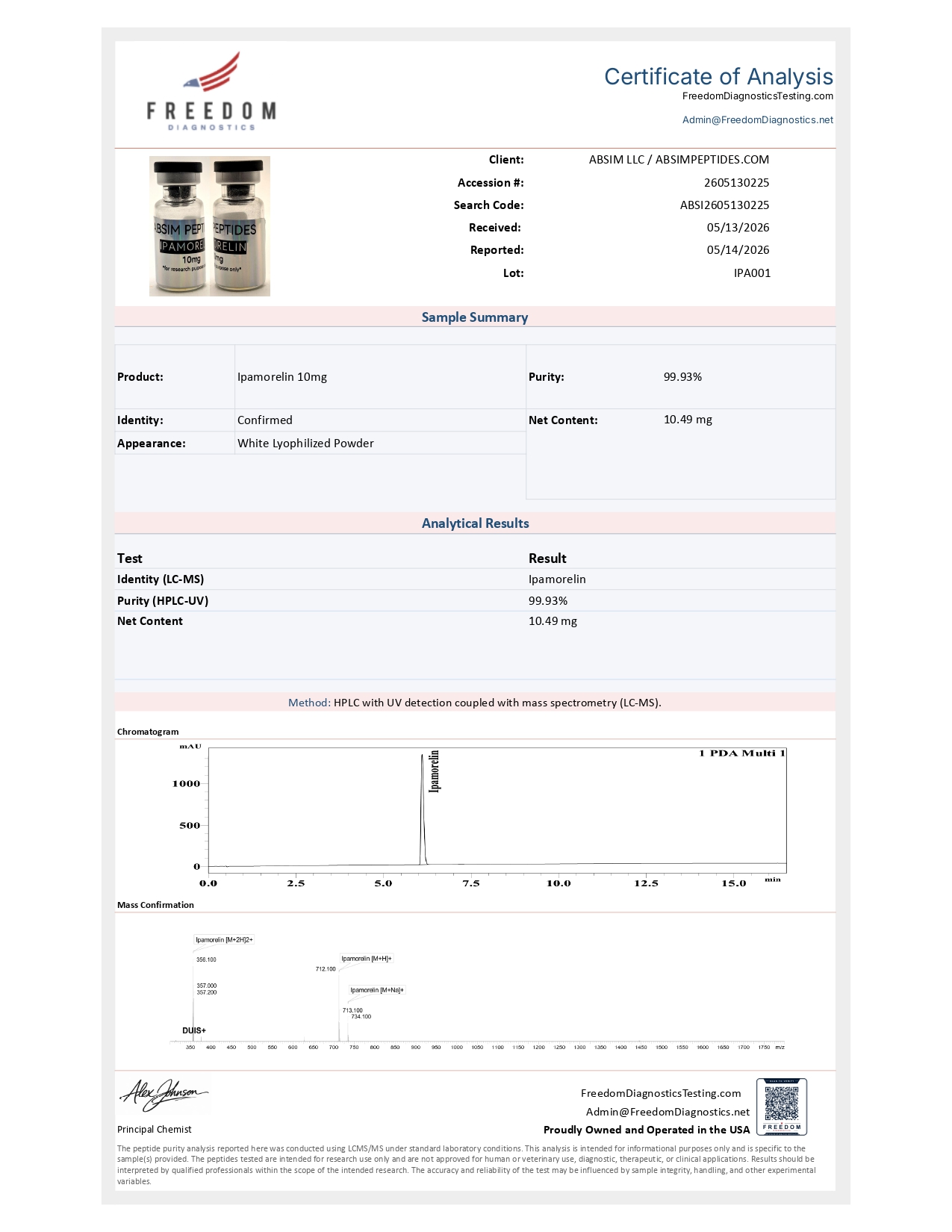
Ipamorelin is a synthetic pentapeptide that acts as a selective agonist of the ghrelin/growth hormone secretagogue receptor (GHS-R). Preclinical research has investigated its ability to stimulate growth hormone release from pituitary cells while maintaining high selectivity. Unlike non-selective secretagogues, Ipamorelin has been studied for its minimal impact on the release of other hormones such as prolactin, thyroid-stimulating hormone, ACTH, luteinizing hormone, follicle-stimulating hormone, or cortisol.
Specifications
- Molecular Formula: C38H49N9O5
- Molecular Weight: 711.86 g/mol
- Sequence: Aib-His-D-2Nal-D-Phe-Lys-NH2
Ipamorelin Peptide Research
Ipamorelin and Growth Hormone Secretagogue Receptors
Ipamorelin is classified as a growth hormone secretagogue receptor 1a (GHS-R1a) agonist, the same receptor targeted by the endogenous hormone ghrelin. In vitro studies indicate that Ipamorelin interacts with GHS-R1a on somatotroph cells in the anterior pituitary, triggering intracellular signaling cascades. This process is believed to involve activation of phospholipase C (PLC), leading to the production of inositol triphosphate (IP3) and diacylglycerol (DAG). IP3 is thought to mobilize calcium ions from intracellular stores, while DAG may activate protein kinase C (PKC), ultimately promoting the exocytosis of growth hormone-containing vesicles.
Research in human volunteers has shown that Ipamorelin administration can significantly elevate growth hormone levels, with reported increases up to approximately 80 mIU/L (about 26.6 ng/mL) compared to placebo baselines around 1.31 mIU/L (0.4 ng/mL).
Ipamorelin and the Musculoskeletal System
Preclinical rat studies have examined Ipamorelin’s potential to counteract glucocorticoid-induced bone loss and support bone formation. Research has associated Ipamorelin with up to a four-fold increase in bone formation rate and improvements in bone mineral density in both existing and newly formed bone. It has also been linked to enhanced osteoblast proliferation, growth, and differentiation, likely mediated through growth hormone and IGF-1 pathways.
Dual-energy X-ray absorptiometry (DEXA) and peripheral quantitative computed tomography (pQCT) measurements in mouse models have shown increases in body mass, bone mineral content (BMC) in the tibia and vertebrae, and cortical bone cross-sectional area. Additional findings suggest Ipamorelin may help mitigate muscle wasting and visceral fat deposition associated with glucocorticoid exposure.
Ipamorelin and Diabetes Research
Murine models of diabetes have been used to study Ipamorelin’s effects on pancreatic islet cells. Research suggests the peptide may promote insulin release through indirect excitation of calcium channels in islet cells, making it a subject of interest for further investigation into type 2 diabetes mechanisms.
Ipamorelin and Muscle / Nitrogen Balance
Studies in glucocorticoid-treated rats have explored Ipamorelin’s potential to improve nitrogen balance and reduce nitrogen wasting in the liver. It has been associated with approximately a 20% decrease in urea-N synthesis (CUNS) under catabolic conditions, reduced expression of urea cycle enzymes, and possible restoration of nitrogen homeostasis across tissues. These effects are thought to relate to modulation of growth hormone and IGF-1 levels.
Ipamorelin as a Ghrelin Receptor Probe
Due to its strong and selective binding to the ghrelin receptor, Ipamorelin has been proposed as a potential molecular probe for positron emission tomography (PET) imaging in research models, particularly in studies involving cardiac function and certain carcinomas where ghrelin receptors are upregulated.
Ipamorelin and Gastrointestinal Motility / Food Intake
In rodent models of postoperative ileus (POI), Ipamorelin has been associated with accelerated gastric emptying and reduced time to first meal intake (by approximately 12 hours) through ghrelin receptor-mediated stimulation of cholinergic excitatory neurons and gastric contractility. It has also been observed to decrease residual radiolabeled food retention in the stomach.
Additional research has examined Ipamorelin’s influence on appetite via ghrelin receptors in the central nervous system. Some animal studies reported an approximate 15% increase in body weight, potentially linked to increased food intake and adipose tissue mass through GH-independent mechanisms.
Important Disclaimer
The products mentioned are intended strictly for laboratory research and in-vitro experimentation. They are not for human or animal consumption. Bodily introduction is strictly prohibited. All information provided is for educational purposes only and does not constitute medical advice. Always refer to our terms and conditions.
This product is strictly for research/laboratory use only. Human or animal use and/or consumption is strictly prohibited by law. Only qualified and licensed professionals should handle these products. Any information found on this site is strictly for educational purposes only. Refer to our terms and conditions for more details.
References
- Raun K, Hansen BS, Johansen NL, Thøgersen H, Madsen K, Ankersen M, Andersen PH. Ipamorelin, the first selective growth hormone secretagogue. Eur J Endocrinol. 1998 Nov;139(5):552-61. doi: 10.1530/eje.0.1390552. PMID: 9849822.
- Johansen PB, Nowak J, Skjaerbaek C, Flyvbjerg A, Andreassen TT, Wilken M, Orskov H. Ipamorelin, a new growth-hormone-releasing peptide, induces longitudinal bone growth in rats. Growth Horm IGF Res. 1999 Apr;9(2):106-13. doi: 10.1054/ghir.1999.9998. PMID: 10373343.
- Sinha DK, Balasubramanian A, Tatem AJ, Rivera-Mirabal J, Yu J, Kovac J, Pastuszak AW, Lipshultz LI. Beyond the androgen receptor: the role of growth hormone secretagogues in the modern management of body composition in hypogonadal males. Transl Androl Urol. 2020 Mar;9(Suppl 2):S149-S159. doi: 10.21037/tau.2019.11.30. PMID: 32257855; PMCID: PMC7108996 https://www.ncbi.nlm.nih.gov/pmc/articles/PMC7108996/
- Jiménez-Reina, L., Cañete, R., de la Torre, M. J., & Bernal, G. (2002). Influence of chronic treatment with the growth hormone secretagogue Ipamorelin, in young female rats: somatotroph response in vitro. Histology and histopathology, 17(3), 707–714. https://doi.org/10.14670/HH-17.707
- Gobburu, J.V.S., Agersø, H., Jusko, W.J. et al. Pharmacokinetic-Pharmacodynamic Modeling of Ipamorelin, a Growth Hormone Releasing Peptide, in Human Volunteers. Pharm Res 16, 1412–1416 (1999).
- Andersen NB, Malmlöf K, Johansen PB, Andreassen TT, Ørtoft G, Oxlund H. The growth hormone secretagogue ipamorelin counteracts glucocorticoid-induced decrease in bone formation of adult rats. Growth Horm IGF Res. 2001 Oct;11(5):266-72. doi: 10.1054/ghir.2001.0239. PMID: 11735244.
- Svensson, J., Lall, S., Dickson, S. L., Bengtsson, B. A., Rømer, J., Ahnfelt-Rønne, I., Ohlsson, C., & Jansson, J. O. (2000). The GH secretagogues ipamorelin and GH-releasing peptide-6 increase bone mineral content in adult female rats. The Journal of endocrinology, 165(3), 569–577. https://doi.org/10.1677/joe.0.1650569
- Adeghate E, Ponery AS. Mechanism of ipamorelin-evoked insulin release from the pancreas of normal and diabetic rats. Neuro Endocrinol Lett. 2004 Dec;25(6):403-6. PMID: 15665799.
- Aagaard, N. K., Grøfte, T., Greisen, J., Malmlöf, K., Johansen, P. B., Grønbaek, H., Ørskov, H., Tygstrup, N., & Vilstrup, H. (2009). Growth hormone and growth hormone secretagogue effects on nitrogen balance and urea synthesis in steroid treated rats. Growth hormone & IGF research: official journal of the Growth Hormone Research Society and the International IGF Research Society, 19(5), 426–431. https://doi.org/10.1016/j.ghir.2009.01.001
- Childs MD, Luyt LG. A Decade’s Progress in the Development of Molecular Imaging Agents Targeting the Growth Hormone Secretagogue Receptor. Mol Imaging. 2020 Jan-Dec;19:1536012120952623. doi: 10.1177/1536012120952623. PMID: 33104445; PMCID: PMC8865914.
- Greenwood-Van Meerveld B, Tyler K, Mohammadi E, Pietra C. Efficacy of ipamorelin, a ghrelin mimetic, on gastric dysmotility in a rodent model of postoperative ileus. J Exp Pharmacol. 2012 Oct 19;4:149-55. doi: 10.2147/JEP.S35396. PMID: 27186127; PMCID: PMC4863553.
- Lall, S., Tung, L. Y., Ohlsson, C., Jansson, J. O., & Dickson, S. L. (2001). Growth hormone (GH)-independent stimulation of adiposity by GH secretagogues. Biochemical and biophysical research communications, 280(1), 132–138. https://doi.org/10.1006/bbrc.2000.4065
Additional information
| SKU | IPA1020260423-01 |
|---|---|
| Categories | Peptides |
| Weight | 1 lbs |
| Dimensions | 3 × 2 × 2 in |
| MG | 10 |
| Purchase Type | Single, 10 Pack |
Related products
-
Tesamorelin 10mg
$42.50 – $285.00Price range: $42.50 through $285.00 Select options This product has multiple variants. The options may be chosen on the product page -
MOTS-C
$26.25 – $450.00Price range: $26.25 through $450.00 Select options This product has multiple variants. The options may be chosen on the product page -
TB-500 10mg
$33.75 – $225.00Price range: $33.75 through $225.00 Select options This product has multiple variants. The options may be chosen on the product page -
BPC 157 10mg
$25.00 – $159.00Price range: $25.00 through $159.00 Select options This product has multiple variants. The options may be chosen on the product page